Labor strikes, higher prices for goods, increased costs of capital. Companies today are dealing with a flurry of challenges. But what makes a company equipped to handle these challenges, or avoid them altogether?
Take Dauch Corp as an example, a critical supplier to major automakers such as GM. The company is under the spotlight following a recent workers' strike, where 1,000 employees walked off a Michigan plant, citing wages lost during a recession.
Dauch's workers going on strike isn't surprising when you look at the underlying financials.
According to RapidRatings' Financial Health Report, Dauch currently has an FHR of 40 out of 100, placing it dangerously close to the below 40 high-risk zone with a shocking 19-point year-over-year decline. Even more concerning is its Core Health Score of 24 out of 100, representing a 28-point year-over-year decline.
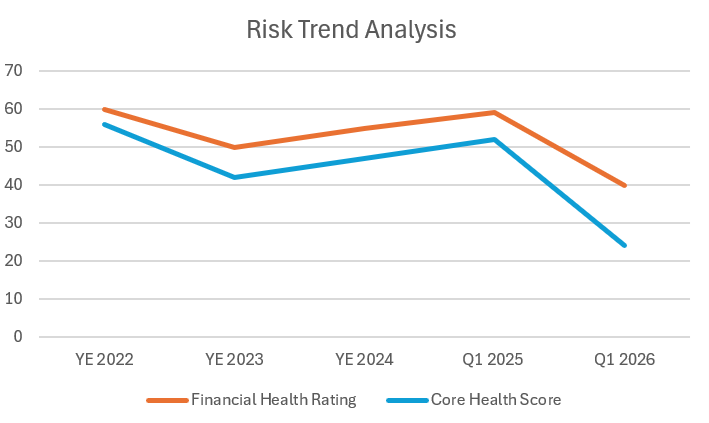
This Core Health Score reflects a structurally constrained business. When suppliers are operating under that level of pressure, organizations may cut corners and neglect important operational initiatives. As a result, labor disputes become much more likely and much harder to resolve.
This is exactly where predictive financial health data provides value. The risk was visible before disruption.
The FHR is the closest thing to a crystal ball, alerting organizations when supplier financials decline and residual risk is increasing.
Learn more about the FHR and how it can help mitigate event risk https://www.rapidratings.com/financial-health-intelligence/the-fhr