This article was originally published in Retail Dive by Caroline Jansen
August 31, 2026 | LINK
Inside Bed Bath & Beyond’s ambitions to transcend retail
A rebrand to Neighborhood Intelligence positions it as “bigger than a retail company.” But a slew of recent acquisitions has drawn skepticism.
----------------
RapidRatings specializes in assessing a company’s near- and medium-term financial health. A Financial Health Rating below a 40 is considered at least a “high risk,” while a Core Health Score below a 40 is considered to be at least in “poor health.”
Bed Bath & Beyond, and the companies it acquired, show poor financial health
The current Financial Health Ratings and Core Health Scores, on a scale of 0 to 100, from RapidRatings.
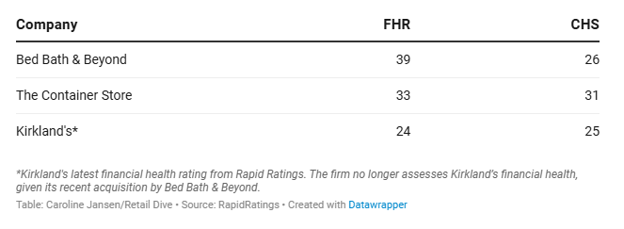
“Having Bed Bath & Beyond at a 39 is almost the identical rating as the original Bed Bath & Beyond when it filed for bankruptcy,” Gellert said. “That doesn’t mean it will file for bankruptcy, but it does mean that it’s not much better than it was.”
The collection of financially weak businesses poses challenges as the new Bed Bath & Beyond navigates its future.
Other companies that have initiated similar acquisition strategies haven’t proven successful, according to Gellert.
The success of Bed Bath & Beyond’s turnaround depends on how well executives can work to bring the various acquisitions together under one roof, while also executing on a new vision for the overall company.
“This is all going to come down to whether the new leadership is able to pull this off,” RapidRating’s Gellert said. “But that’s an awful lot of activity, a lot of real estate, a lot of employees, a lot of history to work through.”
----------------
RapidRatings recently shared financial health data with Retail Dive on companies tied to Bed Bath & Beyond’s latest strategy, including Bed Bath & Beyond, Kirkland’s, and The Container Store.
With each company’s ratings in the high-risk zone—a range where 88% of companies that defaulted had previously been—Executive Chair James Gellert told Retail Dive that combining three risky businesses does not create a stronger one.
“Historically, the retail roll-up strategies that included weaker companies have not fared particularly well,” he said. “A lot of the companies that have done poorly in retail acquisitions kind of look like this — Hudson’s Bay, Toys R Us, Sears, Kmart. … None of the financials are going to make this a success.”
The same risk applies to critical suppliers. Combining companies with weak track records may appear strategic, but poor underlying financial health leaves disruption risk firmly in place.
As we see more private companies wrestling with financial health pressure, including higher leverage and tighter margins, there will be an increase in M&A’s. Roll up strategies and business combinations can sometimes work, but it’s not a guarantee.
For enterprises managing their suppliers that are involved in M&A, the devil is in the details of financial health, where you can determine if an improvement is temporary or long term.
Supplier engagement and collaboration is essential to understanding how a business combination is progressing. Regular financial health assessments can reveal success, failure, or a need for more time.
If your business depends on suppliers undergoing M&A, deeper engagement is needed to evaluate progress and protect outcomes.